Homeowners throughout Westchester County choosing between bluestone and pavers for a new patio, walkway, or outdoor living surface face a comparison that involves more than aesthetics — material performance in Westchester's specific climate and soil conditions, long-term maintenance requirements, cost, and the repairability of each material in the freeze-thaw conditions this region produces are all meaningful factors in the decision.
Pennsylvania bluestone is the classic natural stone choice that has defined Westchester County's residential landscape for generations. Concrete pavers offer design flexibility, lower initial cost, and repair advantages that make them a practical choice for specific applications and site conditions. Neither material is categorically better — the right choice depends on the specific application, the site conditions, the homeowner's aesthetic priorities, and the project budget.
Appearance and Aesthetic Character
Pennsylvania bluestone is a natural stone with organic color variation — gray-blue to blue-green tones with natural surface texture, thickness variation, and the character that only genuine natural material provides. No two slabs are identical. The irregular format creates an organic, naturalistic appearance well suited to garden settings and wooded Westchester properties. Thermal-cut bluestone with machine-sawn edges creates a more formal, refined appearance for front entry walks and estate terraces.
Concrete pavers are manufactured products with consistent dimensions, uniform color options, and a range of surface textures designed to simulate natural stone appearances. Premium tumbled and antiqued concrete pavers do a credible job of approximating the aged stone character — more so than standard smooth-face products that read as clearly manufactured. The consistency of manufactured pavers allows precise pattern execution — herringbone, running bond, basket weave — with the geometric regularity that natural stone's thickness variation makes difficult to achieve.
For homeowners who value the authenticity of natural material, bluestone wins on aesthetics — nothing manufactured fully replicates the character of genuine natural stone.
— Morales Lawn & Garden Team
Cost Comparison for Westchester County
Natural Pennsylvania bluestone carries a higher material cost than concrete pavers — typically 30 to 60 percent more per square foot for material alone in the current Westchester County market. Installation labor for natural bluestone is also higher because irregular stone thickness requires individual adjustment during setting that manufactured pavers don't require.
The total installed cost difference between a bluestone patio and a comparable concrete paver patio on a typical Westchester property runs roughly 40 to 70 percent premium for the bluestone installation. That cost premium is more proportionally significant on larger installations and less significant on smaller ones.
Long-term cost also factors in. Concrete pavers may require joint sand replenishment and occasional resetting more frequently than properly installed bluestone — particularly in Westchester's clay soil conditions where frost heave can displace paver units. Bluestone, once lifted or cracked by frost heave, requires more extensive repair because natural stone panels cannot simply be reset the way individual paver units can.
Need a Material Estimate?
Get a free quote for both bluestone and paver options. We present both transparently so you can decide.
Durability and Frost Performance in Westchester's Climate
Both bluestone and concrete pavers perform reliably in Westchester County's freeze-thaw climate when properly installed on adequate bases. 'Properly installed' means full clay excavation, compacted gravel sub-base, and appropriate bedding layer in both cases — without these base fundamentals, neither material performs adequately.
The freeze-thaw performance difference between the materials is in repairability rather than initial durability. When frost heave displaces a section of a concrete paver installation, individual units can be lifted, the base releveled, and the pavers reset without disturbing adjacent areas. When frost heave lifts and cracks a bluestone slab, repair requires sourcing a matching replacement stone and resetting the affected area — a more involved repair.
For Westchester properties with challenging clay soil conditions, steep slopes, or the hillside terrain common in Putnam County's residential areas, pavers' individual-unit repairability is a genuine long-term advantage worth considering alongside the initial appearance premium of bluestone.
Which Application Favors Which Material?
Bluestone is typically the better choice for:
- Formal estate terraces and entry walks where the premium natural stone aesthetic is a clear priority
- Garden path systems where irregular natural stone integrates with the landscape more convincingly
- Smaller applications where the project cost is modest and the premium is proportionally minor
- Properties in established Westchester communities where natural material is authentically appropriate
Concrete pavers are typically the better choice for:
- Large driveway and parking area installations where vehicle load repairability is a practical advantage
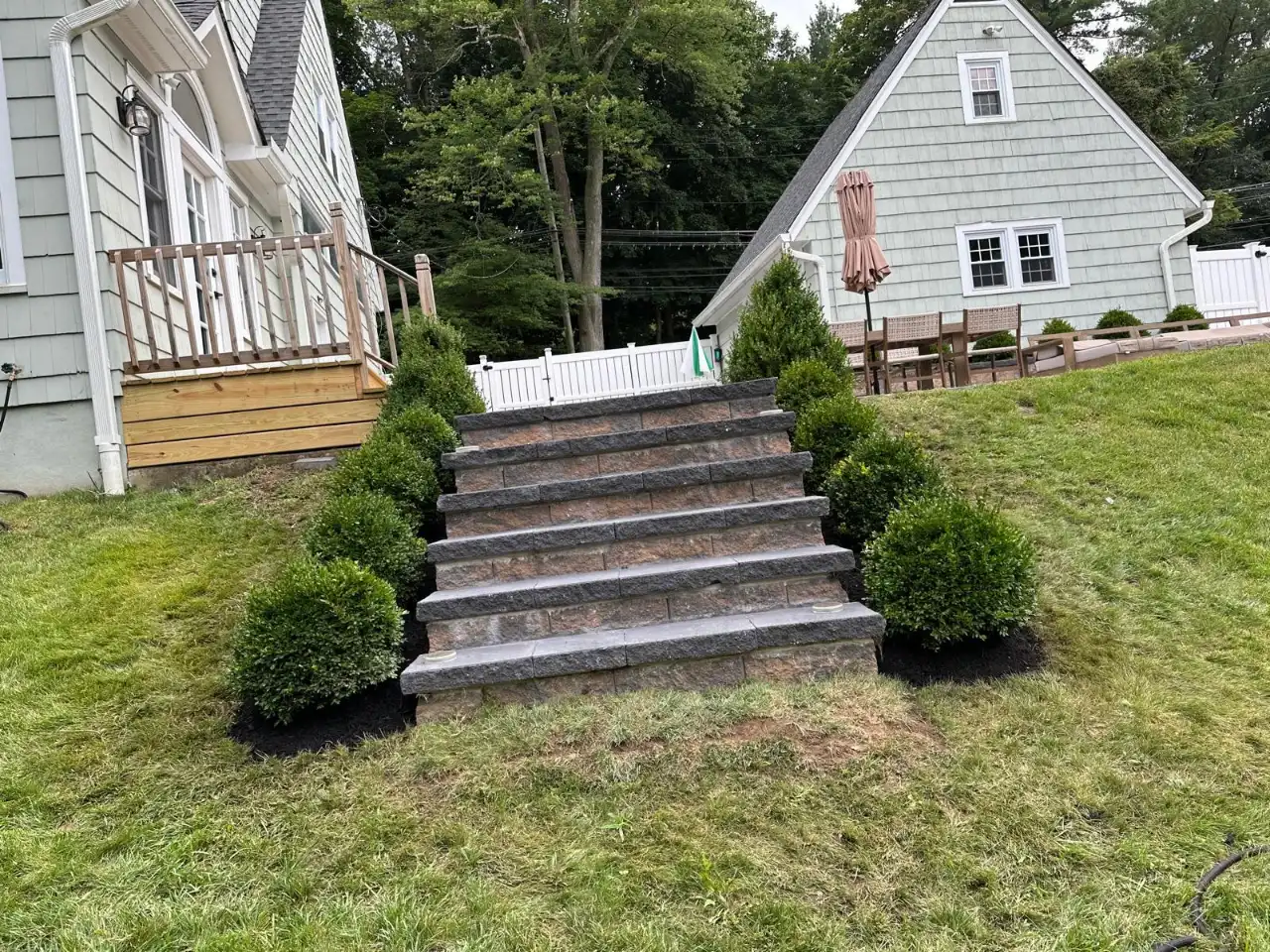
- Hillside and sloped applications where differential settlement makes individual unit resetability more likely needed
- Properties on tighter budgets where the cost savings allow larger installations
- Applications requiring precise design patterns or specific color coordination
Frequently Asked Questions
Can I mix bluestone and pavers in the same project?
Yes — and it's a design approach we use on some Westchester projects. Belgian block borders with bluestone field paving, or paver driveways with bluestone walkways connecting to the home, both create effective material combinations.
Does bluestone really get slippery when wet?
Natural cleft bluestone has a textured surface that provides reasonable slip resistance when wet. Thermal-cut bluestone with a smooth sawn surface is more slippery when wet — particularly in shaded areas where moisture lingers. Sealing smooth-face bluestone improves wet traction.
How long do bluestone and pavers last in Westchester?
Both materials last decades when properly installed. Bluestone installations from the 1950s and 60s are still performing on Westchester properties where the original base construction was done correctly. Concrete paver manufacturers typically warranty their products for 30+ years.
Do I need to seal bluestone or pavers?
Sealing is optional but beneficial for both. Bluestone sealing reduces moisture absorption and efflorescence (white salt deposits). Paver sealing locks joint sand in place and preserves color vibrancy. In Westchester County's shaded conditions, sealing with mildewcide additive helps control algae growth.
Can pavers match the look of bluestone closely enough for formal Westchester estate properties?
Premium tumbled concrete pavers come close on casual and transitional applications. For formal estate terraces and entry walks in Bedford or Armonk where the premium natural stone standard is part of the property's identity, the difference is visible enough that most homeowners choose bluestone.
How do I get an accurate comparison estimate for both materials?
Call us — we provide free estimates for both bluestone and paver installations and present both options transparently so you can see the actual cost difference for your specific project scope before making a decision.
Talk to a Local Contractor Who Works With Both
Morales Lawn & Garden installs both Pennsylvania bluestone and concrete paver systems throughout Westchester and Putnam County. We present both options on every applicable project — explaining the specific advantages and trade-offs for each material in the context of your specific site conditions, project scope, and budget — without a preference for one material over the other.